本記事はAIによる要約です。お気づきの点があればLeave a Replyにご意見ください
Full article: 10.11203/jar.40.164
毒性の化学的痕跡:単一粒子分析が明らかにしたプラスチック混入バイオマス燃焼からの有害煤
現状の課題: 稲わらなどの農業残渣の野焼きは、大気汚染源として知られています。しかし、この燃焼時に廃棄プラスチック(PE、PS、PET)が頻繁に混入するという現実が問題を複雑にしています。この混合燃焼は、単に煙を増やすだけでなく、発生する汚染物質の毒性を根本から変えてしまうのでしょうか?
『エアロゾル研究』に掲載された黒土らによる重要な新論文は、この組み合わせが化学的に遥かに危険であることを明らかにしました。
不完全燃焼が引き起こす化学物質の急増
研究チームは実験炉で燃焼をシミュレートし、プラスチックの混合が二つの主要な変化を引き起こすことを発見しました。
- 有害物質の増幅: 全粒子状物質(PM)が増加しただけでなく、環境上、毒性学上、重大な懸念とされる5環ポリサイクリック・アロマティック・ハイドロカーボン(PAH)が急増しました。
- 燃焼の不全: プラスチックの混入により、燃焼は低温で酸素が不足した燻焼(くすぶり燃焼)へと移行しました。この非効率なプロセスが、大量の有機ガスを放出し、冷却時に凝縮して有害な微小PMを形成します。
微細な証拠:高C/O比の煤粒子
このメカニズムを科学的に検証するため、チームはTEM-EDSを用いた単一粒子分析を実施し、汚染物質の化学的痕跡を特定しました。
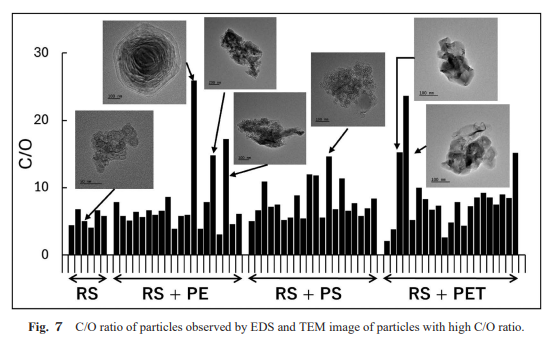
混合燃焼で生成された粒子は、高炭素・低酸素(C/O比が高い)という独自の化学的特徴を頻繁に示しました。このプロファイルは、不完全燃焼の直接的な産物である、新しい高炭素質の煤状・タール状粒子が形成されていることを明確に裏付けています。
図7(高C/O比粒子のTEM画像とC/O比分布)に示されるこの高C/O比は、ソースアポーショメント(発生源寄与)モデルにおいて、より「クリーンな」バイオマス煙と、この極めて毒性の高い混合廃棄物燃焼からのエアロゾルを識別するための信頼できるトレーサーとして機能する可能性があります。本論文は、プラスチックの廃棄物管理と大気質政策の改善に向けた重要な科学的根拠を提示しています。
Full article: 10.11203/jar.40.164
The High Cost of Mixed Burning: Single-Particle Analysis Unveils Hazardous Soot from Plastic-Contaminated Biomass
The Environmental Challenge:
Open field burning of agricultural residues, like rice straw, is a recognized air pollution source. However, a critical real-world complication is the frequent presence of unauthorized plastic waste (PE, PS, PET) in these burn piles. Does this mixture simply create more smoke, or is the resulting pollution fundamentally different and more hazardous?
A new paper in Earozoru Kenkyu (Aerosol Research) by Kurotsuchi et al. confirms that the combination is far more dangerous chemically.
A Chemical Surge from Inefficient Smoldering
The researchers used a lab-scale furnace to simulate open burning. They found that mixing plastics did two key things:
- Chemical Amplification: It caused a significant increase in total particulate matter (PM) and, critically, a sharp rise in five-ring Polycyclic Aromatic Hydrocarbons (PAHs)—compounds of major environmental and toxicological concern.
- Combustion Failure: The plastics forced the burn into a lower-temperature, oxygen-starved smoldering mode. This inefficient process generates a massive amount of gaseous organic precursors that rapidly condense into fine PM.
The Microscopic Evidence: High C/O Soot
To scientifically prove this mechanism, the team used single-particle analysis with TEM-EDS. This provided a chemical fingerprint of the toxic outcome.
The particles from the mixed burn frequently showed a significantly high Carbon-to-Oxygen (C/O) ratio. This profile confirms the formation of new, highly carbonaceous, soot-like and tar-like particles—the direct, harmful products of incomplete combustion.
As illustrated in Figure 7, this high C/O ratio is a clear tracer. For air quality scientists, this means TEM-EDS analysis may be a valuable tool to accurately distinguish between ‘cleaner’ biomass smoke and the far more toxic aerosol from mixed-waste burning in source apportionment models. The findings underscore an urgent need for better waste segregation policies.
| タイトル | バイオマス燃焼時のプラスチック混合による PM 化学組成への影響 |
| Title | Effect of Mixing Plastics during Biomass Combustion on the Chemical Composition of PM |
| 著者 | 黒土優太・関口 和彦・菅原 弘貴・藤谷 雄二・三小田憲史 |
| 掲載誌 | エアロゾル研究 (Earozoru Kenkyu), Vol. 40, No. 3, pp. 164-171 (2025) |
| DOI | 10.11203/jar.40.164 |
AI (Gemini 2.5) による要約