空気中のウイルスを「熱」で制御できるか
冬季に流行するインフルエンザやCOVID-19では、空気中を漂うウイルスを含んだエアロゾルが感染拡大に重要な役割を果たします。マスクや換気、空気清浄機などが広く利用されていますが、本研究では別のアプローチに注目しました。それは、「高温空気による瞬間加熱」です。
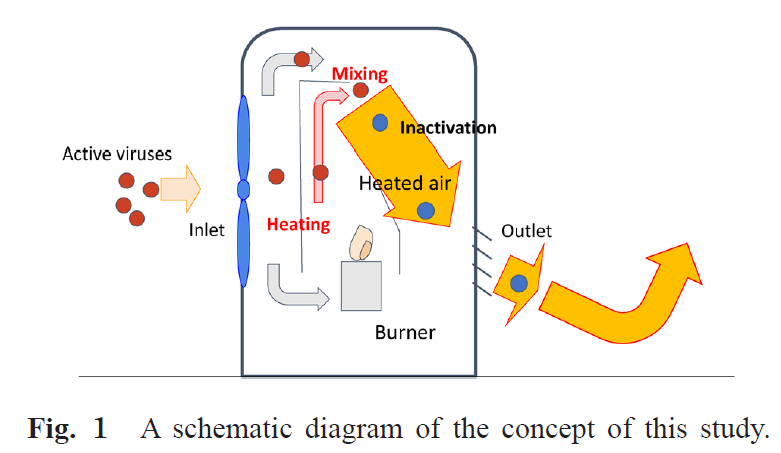
Hidekazu Nishimuraらは、家庭用ファンヒーターを模擬した実験装置を開発し、インフルエンザウイルスを含むエアロゾルを高温流路へ通過させました。 ウイルスは、80~180℃の加熱空気に曝露され、曝露時間は、0.12秒~0.36秒という非常に短い条件で評価されました。
特に興味深かったのは、180℃で0.25秒の条件で、感染性を持つインフルエンザウイルスが約1000分の1まで減少したことです。また、150℃で0.36秒でも約100分の1程度まで減少しました。
一方でウイルスRNA量は比較的維持されており、ウイルス粒子そのものが消失したのではなく、感染能力が失われたことが示唆されました。
本研究の特徴は、「サブ秒(1秒未満)の高温曝露による空気中ウイルス不活化」を定量的に評価した点にあります。
ウイルス液滴を加熱する研究は多くありますが、実際に空気中を浮遊するエアロゾル状態のウイルスを対象とした研究は限られています。 本研究は、空調機器、ファンヒーター、空気殺菌装置、将来の感染症対策システム、などの開発に有用な基礎データを提供しています。
論文情報
Hidekazu Nishimura, Masanori Katsumi, Tomoyuki Suzuki et al.
Inactivation of Airborne Influenza Viruses by Transient Heating for Sub-Second: One-Pass Analyses Using a Fan Heater Simulator
Earozoru Kenkyu, Vol.40, No.1, pp.28-35 (2025) https://doi.org/10.11203/jar.40.28
Can Heat Neutralize Airborne Viruses in Less Than a Second?
Airborne transmission plays an important role in the spread of influenza and COVID-19. While face masks, ventilation, and air cleaners are widely used, this study explored a different strategy: rapid thermal inactivation of airborne viruses.
Hidekazu Nishimura and colleagues developed a fan-heater simulator and exposed influenza-virus-laden aerosols to heated airflow. The aerosols were subjected to: 80°C – 180°C for extremely short residence times of: 0.12 – 0.36 s.
Key Findings
Exposure to 180°C for only 0.25 seconds reduced the amount of infectious influenza virus by approximately three orders of magnitude. At 150°C for 0.36 seconds, the reduction was about two orders of magnitude.
Interestingly, viral RNA levels remained relatively stable, suggesting that the viruses were primarily inactivated rather than physically destroyed.
Why Is This Study Important?
Most previous thermal-disinfection studies focused on viruses in liquids or droplets. This work directly investigated airborne influenza viruses exposed to high-temperature airflow under realistic aerosol conditions.
The results provide useful guidance for: air-cleaning systems, HVAC technologies, thermal disinfection devices, future infection-control engineering, and highlight the potential of thermal treatment as a complementary strategy for airborne pathogen control.
本記事は『エアロゾル研究』掲載論文を広く紹介するため、日本エアロゾル学会(JAAST)が作成した解説記事です。生成AIを編集補助ツールとして活用していますが、内容は原著論文に基づき、学会担当者が確認・編集しています。研究内容の詳細については原著論文をご参照ください。This article was prepared by the Japan Association of Aerosol Science and Technology (JAAST) to introduce research published in Earozoru Kenkyu. Generative AI was used as an editorial support tool. The content has been reviewed and edited by JAAST and is based on the original research paper. Readers are encouraged to consult the original article for full scientific details.