研究の背景
2050年カーボンニュートラルの実現に向けて、CO₂を資源として再利用する「カーボンリサイクル」が注目されています。その代表的な反応の一つが、CO₂メタネーションです。
この反応では、CO₂と水素からメタン(CH₄)を生成できます。生成されたメタンは都市ガスや発電燃料として既存のインフラで利用できるため、社会実装の可能性が高い技術として期待されています。
エアロゾル技術で高性能触媒を合成
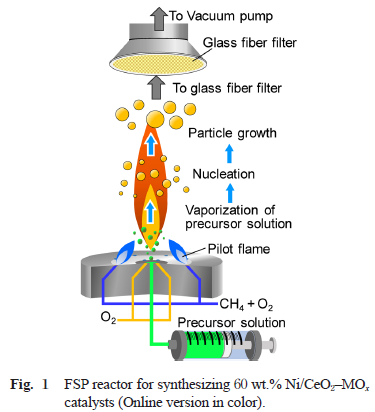
本研究では、Flame Spray Pyrolysis(FSP:火炎噴霧熱分解法)と呼ばれる火炎エアロゾル法を用いて、60 wt.%という高濃度のニッケルを担持したCeO₂系触媒を合成しました。 従来法ではニッケル量を増やしすぎると粒子が粗大化し、性能が低下することが知られています。一方、FSPでは火炎中でナノ粒子を瞬時に形成できるため、高いニッケル濃度でも微細構造を維持できます。
研究のポイント
研究チームはCeO₂にZr、Ti、Y、Mo、Laを少量添加し、CO₂メタネーション性能への影響を調べました。 その結果、Zr添加触媒が最も高い活性を示しました。また、Ti添加、Y添加でも性能向上が確認されました。
一方で、Mo添加、La添加では活性が低下しました。
なぜ重要なのか
興味深いことに、Zr添加によって、Ni粒子サイズ、CeO₂結晶サイズ、Ni表面積はほとんど変化しませんでした。 つまり、「粒子を小さくしたから性能が向上した」のではなく、触媒表面に新しい活性サイトが形成された可能性が示唆されています。これは触媒設計の観点から非常に重要な知見です。
エアロゾル研究としての意義
本研究は、火炎エアロゾルプロセスがエネルギー・環境技術に貢献できることを示した好例です。FSPは本来ナノ粒子製造技術として発展してきましたが、本研究ではその特徴を活かして高性能触媒を創製しています。
エアロゾル工学が、カーボンリサイクル、水素社会、エネルギー変換にどのように貢献できるかを示す興味深い研究と言えるでしょう。
論文情報
Kakeru FUJIWARA, Shintaro TANABE, Koichi HIGASHIMINE, Yugo OSAKA, Takuya TSUJIGUCHI, and Akio KODAMA
Flame Aerosol Synthesis of 60 wt.% Ni Supported on CeO₂–MOx (M: Zr, Ti, Y, Mo, La) for CO₂ Methanation
Earozoru Kenkyu, Vol.40, No.1, pp.36-42 (2025) DOI: https://doi.org/10.11203/jar.40.36
Turning CO₂ into Fuel with Flame-Made Nanocatalysts
Background
Carbon recycling is attracting growing attention as a strategy for achieving carbon neutrality. One promising route is CO₂ methanation, in which carbon dioxide reacts with hydrogen to produce methane (CH₄). Since methane can be transported and utilized through existing natural-gas infrastructure, this technology is considered highly attractive for practical implementation.
Aerosol Technology for Catalyst Manufacturing
In this study, the authors employed Flame Spray Pyrolysis (FSP) to synthesize highly loaded nickel catalysts containing 60 wt.% Ni supported on CeO₂-based materials. Conventional wet-chemical methods often suffer from particle growth when the Ni loading becomes too high. By contrast, FSP enables the rapid formation of nanoparticles in a flame environment, allowing high metal loading while maintaining nanoscale structures.
Key Findings
The researchers introduced several dopants into CeO₂: Zr, Ti, Y, Mo, La and investigated their influence on CO₂ methanation activity. Among all dopants tested, Zr exhibited the strongest promotional effect.
Ti and Y also enhanced catalytic activity, whereas Mo and La led to reduced performance.
Why Is This Important?
Interestingly, the superior activity of the Zr-doped catalyst could not be explained simply by changes in: Ni particle size, CeO₂ crystallite size, Ni surface area because these properties remained nearly unchanged.
The results suggest that Zr incorporation may create new active sites or improve the intrinsic reactivity of existing catalytic sites. This insight is valuable for the rational design of next-generation methanation catalysts.
Significance for Aerosol Science
This work demonstrates how aerosol-based manufacturing techniques can contribute to energy and environmental technologies. Rather than serving only as a nanoparticle synthesis method, flame aerosol processing is shown here to be an effective platform for engineering high-performance catalysts for carbon recycling applications. The study highlights the broader impact of aerosol science in supporting future sustainable energy systems and carbon-neutral technologies.
Recommended Figure
Figure 2a is recommended as the representative figure for the JAAST website because it clearly demonstrates the effect of different dopants on CO₂ methanation activity and immediately communicates the main scientific message of the paper.
本記事は『エアロゾル研究』掲載論文を広く紹介するため、日本エアロゾル学会(JAAST)が作成した解説記事です。生成AIを編集補助ツールとして活用していますが、内容は原著論文に基づき、学会担当者が確認・編集しています。研究内容の詳細については原著論文をご参照ください。
This article was prepared by the Japan Association of Aerosol Science and Technology (JAAST) to introduce research published in Earozoru Kenkyu. Generative AI was used as an editorial support tool. The content has been reviewed and edited by JAAST and is based on the original research paper. Readers are encouraged to consult the original article for full scientific details.