🏆 2026 Best Paper Award
ニッケル63を用いたエアロゾル中和器の性能評価
Evaluation of an Aerosol Neutralizer Using Nickel-63
なぜこの研究が重要なのか?
走査型電気移動度粒径分析器(SMPS)は、ナノ粒子やエアロゾル研究において最も広く利用されている粒径分布測定装置の一つです。SMPSでは、粒子を既知の平衡帯電状態に調整するための「エアロゾル中和器」が不可欠です。 長年、日本国内ではアメリシウム241(Am-241)を用いた中和器が利用されてきました。しかし製造元の事業撤退により、2021年末をもって供給が終了しました。
本研究は、この問題に対する新たな選択肢として、ニッケル63(Ni-63)を用いた中和器 を開発し、その性能を詳細に検証したものです。
研究のポイント
研究チームは100 MBqのNi-63密封線源を用いた試作中和器を製作しました。Ni-63には重要な利点があります。
- 半減期約100年
- β線源
- 日本では規制対象外で使用可能
- 原子力規制委員会への届出不要
という特徴を持ちます。
どのように評価したのか?
著者らは、
- 大気エアロゾル
- 塩化ナトリウム粒子
- スクロース粒子
- PSL粒子による帯電率試験
を用いて従来の Am-241 中和器と比較しました。
主な成果
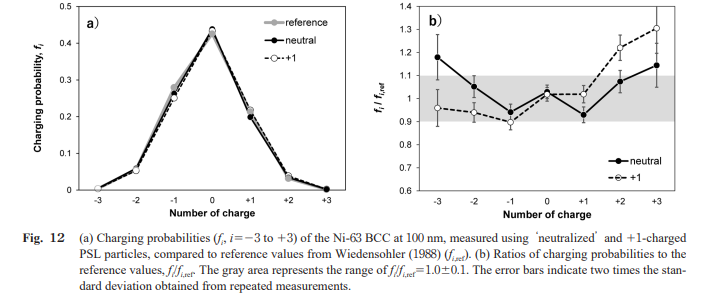
大気エアロゾルおよび塩化ナトリウム粒子では、Ni-63中和器とAm-241中和器はほぼ同等の性能を示しました。 例えば、大気粒子測定では両者の粒子数濃度は非常によく一致し、ISO規格の判定条件も満たしました。 さらに100 nm粒子の帯電率測定では、SMPS測定で最も重要な±1価帯電率が理論値と良く一致することも確認されました。
一方で見えてきた課題
興味深いことに、初期帯電状態が大きく偏ったスクロース粒子では、Ni-63中和器はAm-241中和器より約15%高い粒子数濃度を示しました。 つまり、一般的な計測では十分実用的である一方、特殊な高帯電粒子では注意が必要 であることも明らかにしました。
なぜ論文賞を受賞したのか?
この研究は単なる装置開発ではありません。日本のエアロゾル研究者が日常的に使用しているSMPS計測基盤を維持するための重要な研究です。 さらに、
- ISO規格に準拠した評価
- 理論帯電率との比較
- 実環境エアロゾルによる検証
- 人工粒子による詳細評価
を組み合わせた極めて完成度の高い研究として評価されました。
エアロゾル研究へのインパクト
この成果により、Am-241が入手できない日本国内においても、今後の
- SMPS計測
- DMA分級
- ナノ粒子研究
- 大気観測
を継続できる現実的な選択肢が示されました。
Technical Papers: Evaluation of the Charge Conditioning Performance of an Aerosol Neutralizer Using Nickel-63
JOURNAL OPEN ACCESS 2025 Volume 40 Issue 4 Pages 253-261 https://doi.org/10.11203/jar.40.253
Why Is This Study Important?
The Scanning Mobility Particle Sizer (SMPS) is one of the most widely used instruments for aerosol and nanoparticle measurements. A key component of the SMPS is the aerosol neutralizer, which establishes a predictable charge distribution before electrical mobility analysis. For many years, aerosol researchers in Japan relied on Am-241 neutralizers. However, the supply of Am-241 neutralizers ended in 2021 after the manufacturer discontinued production.
This study evaluated a new aerosol neutralizer based on Nickel-63 (Ni-63) as a practical alternative.
Key Findings
The authors developed a prototype neutralizer incorporating a 100 MBq sealed Ni-63 source and compared its performance with conventional Am-241 neutralizers.
Tests were performed using:
- Ambient aerosols
- Sodium chloride aerosols
- Sucrose aerosols
- Monodisperse PSL particles
under a variety of measurement conditions.
Main Results
For ambient aerosols and sodium chloride aerosols, the Ni-63 neutralizer exhibited performance essentially equivalent to that of the conventional Am-241 neutralizer.
The charging probabilities of ±1 charged particles at 100 nm, which are particularly important for SMPS measurements, showed excellent agreement with reference values.
Remaining Challenges
For highly pre-charged sucrose aerosols, the Ni-63 neutralizer produced particle concentrations approximately 15% higher than those measured using the Am-241 neutralizer.
This finding suggests that while the Ni-63 neutralizer is highly suitable for most practical applications, some caution may be required for aerosols with strongly biased initial charge distributions.
Why Did This Paper Receive the Best Paper Award?
This work addressed a critical challenge faced by the aerosol measurement community in Japan.
By combining:
- ISO-based performance evaluation
- Ambient aerosol measurements
- Laboratory-generated aerosol testing
- Experimental charging probability analysis
the study provided a comprehensive assessment of a realistic replacement for Am-241 neutralizers.
The results provide important guidance for researchers conducting aerosol measurements using SMPS systems in the coming decades.
本記事は『エアロゾル研究』掲載論文を広く紹介するため、日本エアロゾル学会(JAAST)が作成した解説記事です。生成AIを編集補助ツールとして活用していますが、内容は原著論文に基づき、学会担当者が確認・編集しています。研究内容の詳細については原著論文をご参照ください。This article was prepared by the Japan Association of Aerosol Science and Technology (JAAST) to introduce research published in Earozoru Kenkyu. Generative AI was used as an editorial support tool. The content has been reviewed and edited by JAAST and is based on the original research paper. Readers are encouraged to consult the original article for full scientific details.