なぜこの研究が重要なのか?
グローブボックスの窓、工場設備の透明パネル、建物や乗り物の窓、さらには保護メガネなど、透明材料への粉じんやエアロゾル粒子の付着は視認性や作業性を低下させます。特に放射性物質や有害粉体を扱う環境では、清掃そのものが大きな負担となります。
本研究では、「透明性を維持したまま粒子を付着しにくくする方法」として、シリカナノ粒子コーティングに着目しました。
研究のポイント
研究チームは、アクリル、ポリカーボネート、という透明樹脂基板を対象としました。まず基板表面をポリエチレンイミンで改質し、その後シリカナノ粒子水分散液をエアブラシで塗布しました。有機溶媒を用いないため、樹脂材料へのダメージを抑えられることも特徴です。
主な成果
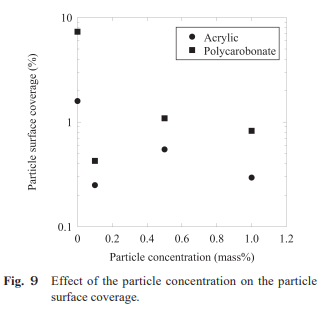
シリカ濃度 0.1 mass% のコーティング条件において最も高い効果が得られました。粒子付着力は、
- アクリル基板:39.0 nN → 5.4 nN
- ポリカーボネート基板:38.4 nN → 3.7 nN
まで低下しました。
これは付着力が
- アクリルで約13.8%
- ポリカーボネートで約9.6%
まで低減されたことを意味します。
なぜ付着が減るのか?
ナノ粒子コーティングによって表面に微細な凹凸構造が形成されます。その結果、粒子と基板が直接接触する面積が減少し、ファンデルワールス力が弱くなります。 つまり、「粒子が乗る場所を減らして付着しにくくする」という考え方です。
エアロゾル研究としての意義
本技術は、グローブボックス、放射性粉体取扱設備、防塵窓、計測装置の透明カバー、各種産業設備への応用が期待されます。 さらに、透明性を維持しながら粒子付着を抑制できることから、安全性と保守性の向上につながる可能性があります。
Technical Papers: Prevention of Aerosol Adhesion on Resin Substrate by Nanoparticle
JOURNAL OPEN ACCESS: 2025 Volume 40 Issue 4 Pages 245-252, https://doi.org/10.11203/jar.40.245
Why Is This Study Important?
Particle deposition on transparent surfaces is a common problem in glove boxes, industrial observation windows, transportation systems, and protective equipment. Accumulated particles reduce visibility, safety, and operational efficiency. This study investigated a simple nanoparticle-coating strategy to reduce particle adhesion while maintaining transparency.
Research Highlights
The authors applied silica nanoparticle coatings onto acrylic substrates and polycarbonate substrates, after surface modification using polyethyleneimine. Unlike conventional approaches, the method uses water-based dispersions and avoids organic solvents, making it suitable for sensitive polymer materials.
Key Findings
The best performance was achieved using a silica concentration of 0.1 mass%.
Particle adhesion forces decreased from:
- 39.0 nN to 5.4 nN for acrylic
- 38.4 nN to 3.7 nN for polycarbonate
corresponding to reductions to approximately:
- 13.8% of the original value (acrylic)
- 9.6% of the original value (polycarbonate)
Why Does It Work?
The nanoparticle coating creates microscopic surface roughness. This roughness reduces the actual contact area between particles and the substrate, thereby lowering adhesion forces. The concept is simple: less contact area means lower particle adhesion.
Significance for Aerosol Science
The study demonstrates a practical application of nanoparticle engineering to control particle deposition. Potential applications include: glove boxes, radioactive-material handling systems, optical inspection windows, transparent protective covers, industrial process equipment, where visibility and contamination control are both critical.
本記事は『エアロゾル研究』掲載論文を広く紹介するため、日本エアロゾル学会(JAAST)が作成した解説記事です。生成AIを編集補助ツールとして活用していますが、内容は原著論文に基づき、学会担当者が確認・編集しています。研究内容の詳細については原著論文をご参照ください。This article was prepared by the Japan Association of Aerosol Science and Technology (JAAST) to introduce research published in Earozoru Kenkyu. Generative AI was used as an editorial support tool. The content has been reviewed and edited by JAAST and is based on the original research paper. Readers are encouraged to consult the original article for full scientific details.